From Paper Fortune Teller to Pocket Plaything
Make a paper fortune teller easier to fold, handle and share, with fixes for slipping flaps, cramped writing and games that run out of steam.
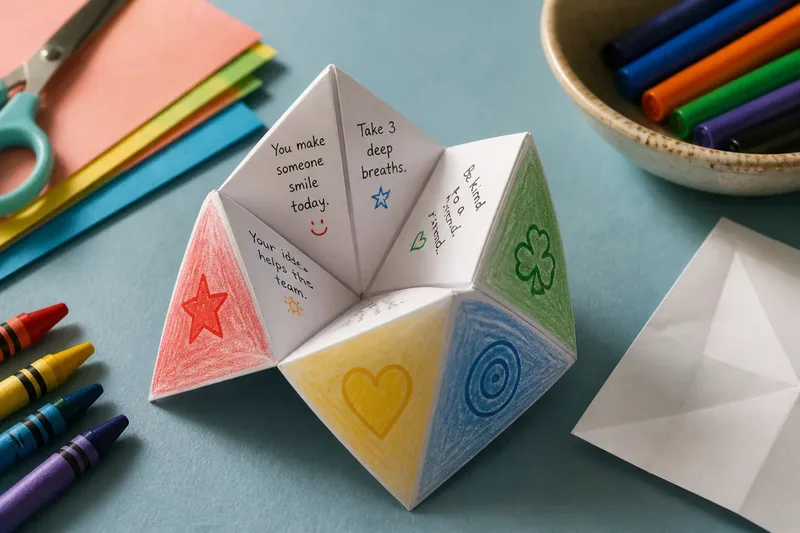
The most common paper fortune teller mistake is starting with a sheet that is too small or too floppy: the finished toy buckles in your fingers, and the game stalls before anyone has picked a flap. A paper fortune teller works best as a shared pocket plaything when the folds open cleanly and the prompts invite a next turn. A few small adjustments can fix the usual snags without turning a quick game into a craft project.
Why does the fortune teller feel awkward in your hands?
If the corners are hard to pinch, check the paper before blaming your folding. A tiny square leaves little room for fingers, while very thin paper can crumple around the central folds after repeated opening and closing.
Begin with ordinary printer paper cut into a square. If you want a sturdier feel, try light card only if it folds without cracking; thick card often fights the multiple layers at the centre. For a pocket version, choose a square that fits comfortably across your palm when folded, rather than aiming for the smallest possible toy.
Keep the paper flat as you make each crease. Run a fingernail or the back of a spoon along the fold, then open the paper fully before making the next set of folds. A clean crease is like the hinge on a small box: it helps the moving parts bend in the intended place instead of buckling somewhere nearby.
What if the corners do not meet?
Misaligned corners usually come from folding by eye while the sheet is still shifting. Start with a true square; if you cut one from a rectangular sheet, bring one short edge across to meet a long edge, crease the diagonal, and trim away the strip that remains. Open it out and check that the opposite corners line up before folding the toy.
As you fold the square towards its centre, bring each corner to the same central point. Do not pull one corner past the centre to make it look sharper: that small overreach can leave the finished fortune teller lopsided and make one flap harder to open. If a crease has gone wrong, unfold it and smooth the paper before trying again.
Once all four corners meet, turn the paper over and fold the new corners in towards the centre as well. The layers should lie flat. If the middle becomes too bulky to press, pause and check whether one corner has been folded in the wrong direction rather than forcing it down.
How can you stop the pockets from popping open?
The four pockets need to hold their shape while leaving enough room for fingertips. Push the folded form together gently along its main creases, then slide a thumb and forefinger under each pair of flaps to open the pockets. Work the paper back and forth a few times; a stiff fold often needs easing, not a harder tug.
If a pocket springs loose, check that the corners are tucked towards the centre on both sides and that the central folds are sharp. Avoid taping the flaps shut, since the toy depends on them moving. A small piece of tape on the outside may seem like a quick fix, but it can snag fingers and make the opening uneven.
Say you have folded a fortune teller from a square of printer paper, but one pocket keeps collapsing as you try to place your fingers. Imagine reopening it, sharpening the crease at that pocket’s base and easing the four flaps apart with your fingers; the expected result is a pocket that stays open long enough to hold and operate the toy, without adding extra material.
What should you write inside the flaps?
Cramped writing makes a fortune teller harder to read and less fun to pass around. Use short words, simple choices or tiny prompts, and leave a little breathing room near each fold so the text does not disappear into a crease. A felt-tip pen gives bold letters, while coloured pencils or crayons add colour without making the paper feel wet.
Plan the writing before you decorate. The outside sections can carry colours or symbols, and the inner flaps can hide outcomes, dares or friendly questions. Keep prompts easy to understand and suitable for the people playing; the game works better when nobody has to stop to decipher a long instruction.
- For a quick round: write a colour on each outer section and a short, cheerful result under each inner flap.
- For a group: use prompts that let the next player choose or answer, rather than putting one person on the spot.
- For a quieter game: add small choices such as naming a favourite snack or picking a pretend destination.
Leave space for the folds to move. If a word crosses a crease, rewrite it smaller or shift it towards the centre of its flap. Decorating every blank patch can make the toy look busy and leave its hidden messages difficult to read.
How do you keep the game moving between players?
A paper fortune teller becomes a shared game through its turn-taking, not through elaborate rules. One player chooses an outside symbol; the holder opens and closes the toy in time with the letters or numbers in that choice. The player then picks from the newly visible options, and the holder opens the selected flap to reveal its message.
Agree on a simple rhythm before starting, especially if several people are waiting. Let the person whose turn it is choose the colour or symbol and the final flap. That small handover keeps the object in one person’s hands at a time while giving the next player a clear part in the game.
If a round feels repetitive, change the hidden prompts rather than making the mechanism more complicated. A set of kind compliments, silly imaginary jobs or choose-one questions can give the same folded toy a different mood. Keep the rules light enough that a new player can join after watching one turn.
Which small problems are easiest to fix?
Why does one side look bigger than the other?
The original square may be uneven, or a corner may have missed the centre during folding. Open the paper, check the square’s edges and refold slowly with each tip meeting the same point.
Why will the centre not lie flat?
Several layers may have gathered because one fold was pushed beyond the middle. Unfold the last set of corners, flatten the sheet and bring each one in just to the central meeting point.
Why are the messages hard to read?
The writing may be too large, too close to the creases or hidden beneath a flap. Shorten the wording and place it in the centre of each panel, then test the toy’s movement before adding decoration.
Why does the game stop after one round?
The prompts may be too similar or give the player nothing to do next. Swap in a mix of choices, questions and playful actions, and let each person take a turn choosing what appears beneath a flap.
How can you make the fortune teller a pocket keepsake?
A pocket plaything is easy to carry when it folds flat and has a clear place to live. Slip it into a notebook pocket or a small envelope, and add the player’s name or a tiny title on the outside so it is easy to find later. If the paper starts to soften, store it flat rather than crushed at the bottom of a bag.
Keep the keepsake personal without making it precious. A date, a shared in-joke or a set of prompts chosen by the group can recall the people who played, while leaving the toy ready for another round. The best paper fortune teller is not the most decorated one; it is the one whose folds still open easily and whose hidden words make someone want to choose again.
For a paper fortune teller that travels well, check the crease, the pocket opening and the legibility of each message before you tuck it away. Those quick checks preserve the small, satisfying transformation at its heart: a single folded sheet becomes something two people can take turns holding, choosing and opening.