Cardboard, Cereal Boxes or Tubes: Choosing a First Build Material
Choose cardboard, cereal boxes or tubes for a first build by matching their ready-made shapes to a small construction you can cut, fold and join.
The common mistake in a first cardboard build is reaching for the thickest piece, then wrestling it into a shape it resists. Match cardboard, cereal boxes or tubes to the form you want, and the material can do part of the work before you cut.
What kind of shape do you want to start with?
Choose a small construction you can describe in a sentence: a standing sign, a little bridge, a tunnel or a box with a lid. You are not settling every design detail; you are deciding what shape the material needs to support.
A delivery box offers broad, flat panels and ready-made creases. A cereal box gives you light card with existing folds and printed surfaces. A cardboard tube starts as a hollow cylinder. They are like a tray, a folded carton and a drinking glass: each form makes some ideas easier to begin.
When does flat cardboard make the best starting point?
Choose corrugated cardboard for a construction with upright panels, such as walls, a ramp, a simple stage or a bridge deck. Its fluted middle gives it more body than thin carton card, and its broad faces are easy to sketch on and mark for folding.
Look for a clean, dry piece without crushed corners or deep creases where you need a straight edge. Corrugations can resist a fold across their direction, so try scoring a spare strip before working on the main panel. Scissors can cut thinner sections; a craft knife is sharp and should be handled carefully by an adult on a cutting mat.
Thick cardboard can be bulky, with ragged cut edges and joints that ordinary glue may not hold neatly. Start with a single panel or a simple slot connection before adding layers.
Why choose a cereal box for folded forms?
Cereal-box card suits small builds that rely on bends and tabs: a little house, a desk organiser or a shallow tray. It is light enough for household scissors and may already have crease lines from its original carton.
Flatten the box and inspect its panels before drawing. Broad faces can become large shapes; narrow side panels can make braces or tabs. Printed graphics may add colour, but existing creases can influence where a wall bends, so plan around them.
This card is less forgiving if bent repeatedly in different directions. A sharp crease can split its surface, and a large unsupported wall may sag. For a compact object its lightness is useful; for a construction spanning a gap, a sturdier panel may be easier to manage.
What can a tube do that flat card cannot?
A tube already has a rounded, hollow shape, making it a natural start for a tunnel, telescope prop, little tower or pair of legs. Its curved wall and open ends can become features of the object rather than shapes you need to build from scratch.
Check that the tube is dry, clean and not crushed. A narrow tube leaves little room for inserting another part; a wider one can take a rolled-card connector or frame an opening. A slot can weaken the curved wall, so keep openings modest and try a spare tube first if one is available.
Tubes are awkward when a design needs a broad, level face. Add a separate card panel for a roof or platform instead of expecting the curved surface to behave like a board.
How should you compare the materials before cutting?
Put the candidates beside your sketch and ask which one already supplies the most useful part of the shape. Then consider how the remaining pieces could attach: a tab and slot, a folded flap or a small amount of paper tape may be enough for a playful model.
- For wide walls or a ramp: If a flat corrugated panel is clean and its creases miss the planned edges, use it; if it is crushed or badly creased, choose a clearer panel or simplify the shape.
- For a folded shell or small box: If cereal-box card has usable panels and creases, plan the folds around them; if a crease crosses a needed wall, rotate the outline or choose another piece.
- For a tunnel or rounded upright: If a tube is clean and holds its shape, start with it; if it is crushed, use an undamaged tube or make the rounded form from folded card.
- For a build combining shapes: If each material has a distinct job, such as tube for a tower and carton card for a roof, combine them; if the joint is hard to position, simplify the build or use one material.
- For a joint that may not fit: If a small offcut holds the pieces in the intended position, use that connection; if it slips, widen the tab, add a folded flap or try paper tape.
- Before cutting a curved wall: If a trial slot leaves the spare tube intact, make a similar opening; if the wall splits or collapses, avoid the slot and attach the part with a wraparound band.
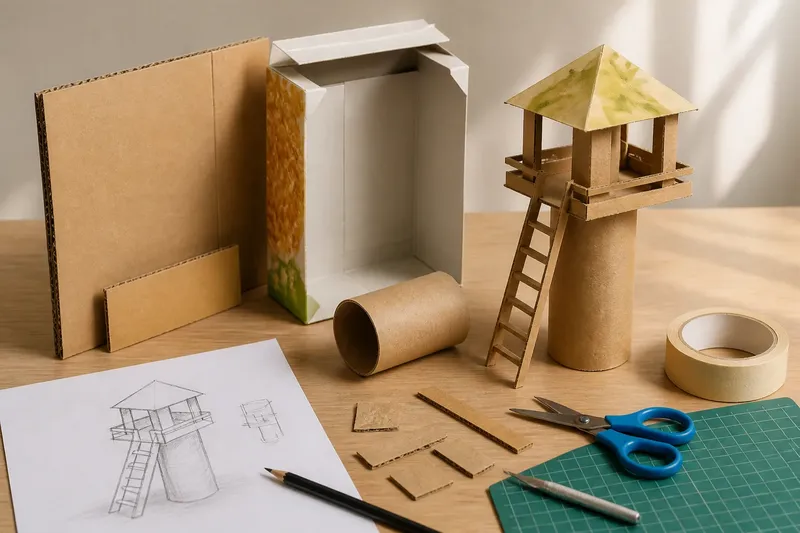
Say you have a clean tube, one cereal-box panel and a sketch of a tiny lookout tower. First, stand the tube upright on a flat table; then fold two tabs into the card panel and rest it across the tube as a roof. If the roof tips during this dry fit, shorten its overhang and widen the tabs; the expected result is a roof that sits more level, though the wider tabs leave less room for decoration.
Which material suits a first build?
Can cereal-box card hold a small roof?
It can suit a light roof, especially when folded edges or tabs support it. If the roof droops during a dry fit, shorten its span or add a folded-card brace.
Is a cardboard tube useful as a building support?
A tube can act as an upright or hollow column, but its curved wall offers a narrow place to attach a flat piece. A broad tab or wraparound band can give the joint more contact.
Can different found materials be combined?
Yes, when each piece has a distinct purpose and the connection is easy to inspect. Try the fit before adding decoration, so you can still adjust a loose joint.
What should I do if the first material feels difficult to work?
Pause before cutting more and check whether the difficulty comes from the material or the chosen shape. Switching from a wide panel to a tube, or simplifying one bend, can make the same idea easier to explore.
What should you check before decorating?
Set the bare construction on a level surface and look for leaning walls, slipping tabs and edges that snag. Adjust the shape while its joints are visible; paint, stickers and extra layers can hide a connection that still needs attention.
For a first build, choose the material whose ready-made shape does useful work: panels for planes, carton card for folds, or tubes for rounded forms. Keep the offcuts nearby; a narrow strip can become a brace, tab or test piece for the next part of your design.